Showing posts with label IN CAMPAIGN. Show all posts

Thursday, September 18, 2014

ETERNAL distances


ETERNE LONTANANZE

Suonano le campane
per qualche santo che non conosco
in queste ore certamente sante,
e il suono arido per la campagna
si sparge senza risonanze
tra la paglia bruciata, tra le piante
che non san fare un bosco,
si perde per le valli malsane,
e con l’umile terra esso si lagna
paziente, delle eterne lontananze.

Carlo Levi settembre 1935

Pictures  SPERA GERARDO - POMARICO (ITALY)

Saturday, July 26, 2014

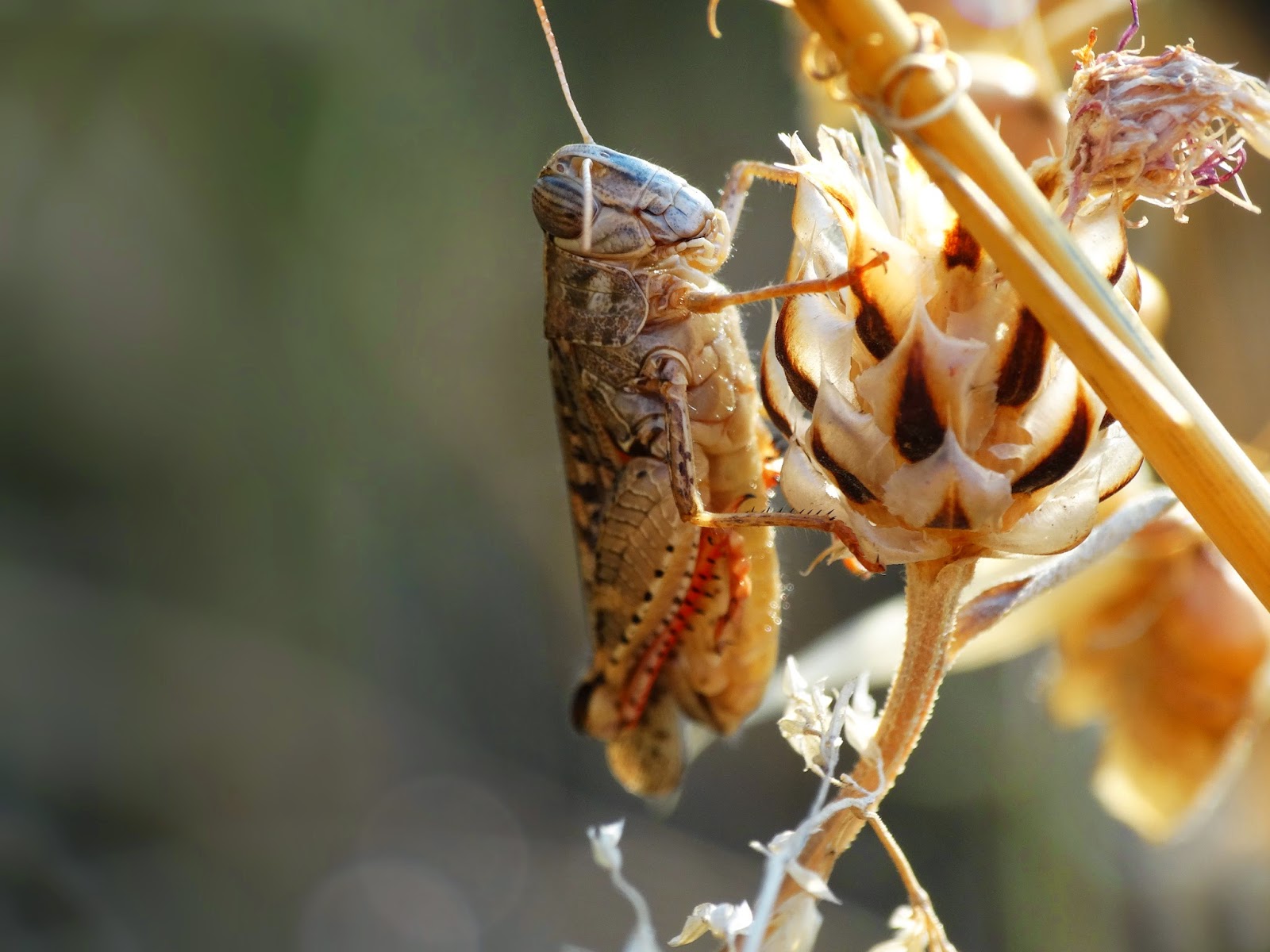
Crickets of the Manferrara forest - Pomarico (MT)


  Pictures by SPERA GERARDO - POMARICO (ITALY)

Tuesday, July 1, 2014

Dragonfly (Pomarico MT)


 Pictures by SPERA GERARDO - POMARICO (ITALY)

Tuesday, April 22, 2014

I cannot meet the Spring unmoved

   
I cannot meet the Spring unmoved

I cannot meet the Spring unmoved --
I feel the old desire --
A Hurry with a lingering, mixed,
A Warrant to be fair --

A Competition in my sense
With something hid in Her --
And as she vanishes, Remorse
I saw no more of Her.

by Emily Dickinson
 Pictures by SPERA GERARDO - POMARICO (ITALY)

Saturday, March 29, 2014

Spider: Argiope Lobata, Pomarico (MT) ITALY


ARGIOPE LOBATA
 Argiope Lobata are located around the Mediterranean and is a very common species in the Iberian Peninsula and is frequently found in zones of high grass, as well as in little dense matos, in which it constructs its web. Argiope lobata is a spider of showy aspect. 
The females reach 18-22 mm (length of the body without appendices), the males reach only 6-8 mm. Females have a visibly flattened back-ventral, with three or four pairs of lateral wolves (a characteristic which gives it the name "lobata") and a posterior terminal prominence; the coloration is changeable, and even so it can present transversal lists alternating black and yellow, most commonly it is almost total silver plated. Its carapace completely is covered of small gray-silver-plated coats and the leg are long and of black colour, with changeable intensity, consistent with the phase of development of the animal. 
The ventral face is sprinkled with black colour, and chestnut to dark yellow. They present similar legs and carapace to the female, but without visible wolves in abdomen; it is small, and totally silver plated in the dorsal face. The web is orbicular, slightly inclined and with a stablimentum typically in a zigzag form, varying between individuals. The spider sits in the centre, with legs grouped two and two...

                                                       Pictures by SPERA GERARDO - POMARICO (ITALY)

Monday, July 1, 2013

And All i need...


Pictures by SPERA GERARDO - POMARICO (ITALY)

Wednesday, March 20, 2013

The saddest noise, the sweetest noise


Emily Dickinson (1830 - 1886)
The saddest noise, the sweetest noise

The saddest noise, the sweetest noise,
  The maddest noise that grows,—
The birds, they make it in the spring,
  At night’s delicious close.

Between the March and April line—
  That magical frontier
Beyond which summer hesitates,
  Almost too heavenly near.

It makes us think of all the dead
  That sauntered with us here,
By separation’s sorcery
  Made cruelly more dear.

It makes us think of what we had,
  And what we now deplore.
We almost wish those siren throats
  Would go and sing no more.

An ear can break a human heart
  As quickly as a spear,
We wish the ear had not a heart
  So dangerously near.

Pictures by SPERA GERARDO - POMARICO (ITALY)

Friday, April 16, 2010

NEW LIFE APRIL 2010


Fall

You may see me struggle but you wont see me fall. Regardless if I'm weak or not I'm going to stand tall. Everyone says life is easy but truly living it is not.times get hard, people struggle& constantly get put on the spot. I'm going to wear the biggest smile even though I want to cry. I'm going to fight to live even though I'm destined to die. and even though it's hard & I may struggle through it all. you see me struggle...you will NEVER see me fall.

Pictures taken By Spera Gerardo at Pomarico (Italy).

Monday, July 27, 2009

JULY 2009

Da JULY 16/2009

Da JULY 16/2009

Da JULY 16/2009

Sonnet XII

crave your mouth, your voice, your hair. Silent and starving, I prowl through the streets. Bread does not nourish me, dawn disrupts me, all dayI hunt for the liquid measure of your steps. I hunger for your sleek laugh,your hands the color of a savage harvest,hunger for the pale stones of your fingernails, I want to eat your skin like a whole almond. I want to eat the sunbeam flaring in your lovely body, the sovereign nose of your arrogant face, I want to eat the fleeting shade of your lashes, and I pace around hungry, sniffing the twilight, hunting for you, for your hot heart, like a puma in the barrens of Quitratue.

Pictures taken By Spera Gerardo at Pomarico

Sunday, November 2, 2008

MEDITERRANEAN SCRUB

Mediterranean scrub Two principal varieties are recognized on the basis of the stature of the constituent shrubs. The tall variety is called maquis, the short variety garrigue; but the distinction is somewhat arbitrary and there are many intergrade types. Both occupy vast areas and were derived by burning and grazing from an earlier forest cover. Indeed, constant use of fire has created distinctive plant associations within the scrub, such as the giane (rosemary and Genista species) and ericeto (tree heath) in southern Italy. In Iberia such associations are even more extensive and include the brezales (heathers), jorales (Cistus species), goscojales (Quercus coccifera, kermes oak) and bujedales (Buxus sempervirens, box).
Maquis (French) or macchia (Italian; plural macchie) is a shrubland biome in the Mediterranean region, typically consisting of densely growing evergreen shrubs such as sage, juniper and myrtle. It is most often associated with Corsica but is widely found on the mainland as well.
It is similar to the English heath in many aspects, but with taller shrubs, typically 2-4 m high as opposed to 0.2-1 m for heath. A similar habitat type in North America is known as chaparral, though the kinds of shrubs involved are different.
Although maquis is by definition natural, its appearance in many places is due to destruction of forest cover, mainly by frequent burning that prevents young trees from maturing. It tends otherwise to grow in arid, rocky areas where only drought-resistant plants are likely to prosper.
The word comes from the plural of Italian macchia (English thicket). The extremely dense nature of maquis made it ideal cover for bandits and guerrillas, who used it to shelter from the authorities. It is from this meaning that the Second World War French resistance movement, the Maquis, derived its name. In Italian darsi alla macchia means becoming a fugitive.

Garrigue is a type of low, soft-leaved scrubland found on limestone soils around the Mediterranean Basin, generally near the seacoast, where the climate is ameliorated, but where annual summer drought conditions obtain. The term has also found its way into haute cuisine, suggestive of the resinous flavours of a garrigue shrubland. UNEP World Conservation Monitoring Centre described garrigue as "discontinuous bushy associations of the Mediterranean calcareous plateaus, often composed of kermes oak, lavender, thyme, and white cistus. There may be a few isolated trees."

Aside from dense thickets of kermes oak that punctuate the garrigue landscape, juniper and stunted holm oaks are the typical trees; aromatic lime-tolerant shrubs such as lavender, sage, rosemary, wild thyme and Artemisia are common garrigue plants.
The aromatic oils and soluble monoterpenes of such herbs leached into garrigue soils from leaf litter have been connected with plant allelopathy, which asserts the dominance of a plant over its neighbors, especially annuals, and contributes to the characteristic open spacing and restricted flora in a garrigue. The fines (charred wood and smoke residues, or charcoal dust) of periodic brush fires also have had an effect on the patterning and composition of the garrigues. Clear summer skies and intense solar radiation have induced the evolution of protective physiologies: the familiar glaucous, grayish-green of garrigue landscapes is produced by the protective white hairs and light-diffusing, pebbled surfaces of many leaves typical of garrigue plants.
Pictures taken By Spera Gerardo at Pomarico (Italy)

Tuesday, October 14, 2008

OPUNTIA FICUS - INDICA

Opuntia ficus-indica (Indian Fig Opuntia) is a species of cactus and a long-domesticated crop plant important in agricultural economies throughout arid and semiarid parts of the world. Indian Fig Opuntia is grown primarily as a fruit crop, but also for the vegetable nopales and other uses. Most culinary references to the "prickly pear" are referring to this species. The name "tuna" is also used for the fruit of this cactus, and for Opuntia in general (according to Alexander von Humboldt, it was a word of Haitian origin taken into the Spanish language around 1500).
Cacti are good crops for dry areas because they efficiently convert water into biomass. Opuntia ficus-indica, as the most widespread of the long-domesticated cactuses, is as economically important as corn and tequila agave in Mexico today. Because Opuntia species hybridize easily (much like oaks), the wild origin of Opuntia ficus-indica (or even whether it has a single origin) is hard to be certain about, but Opuntia was eaten by humans at least 9000 years before the present.
The most commercially valuable use for Opuntia ficus-indica today is for the large, sweet fruits, called tunas. Areas with significant tuna-growing cultivation include Mexico, Sicily and the coasts of Southern Italy, Algeria, Egypt, Saudi Arabia, Chile, Brazil, and northern Africa, as well as in Eritrea and Ethiopia where the fruit is called beles.
In Sicily, where the Prickly Pear Fruit is known as ficodinnia (the Italian name being fico d'India), the cactus grows wild and cultivated to heights of 12-16'. The fruits flower in three distinct colors, White, Yellow and Red. They first appear in early May through the early summer and ripen from August through October. The fruits are typically eaten, minus the thick outer skin, after chilling in a refrigerator for a few hours. They have a taste similar to a juicy extra sweet watermelon, very refreshing on a hot summer or fall day. The bright red/purple, or white/yellowish flesh contains many tiny hard seeds that are usually swallowed, but should be avoided by those who have GI problems with seeds.

In the center of Sicily, in the Provence of Enna, in a small village named Gagliano Castelferrata, a Prickly Pear flavored liqueur is produced called "Ficodi", flavored somewhat like a medicinal/aperetif. In the early 1900s, in the United States the Prickly Pear fruit was imported from Sicily and other Mediterranean countries to satisfy the growing population of immigrants arriving from Italy (Sicily)and Greece. The fruit lost its popularity during the mid 1950's and has become increasing in popularity recently in the late 1990s until today, due to the influx of Mexican immigrants. Recently the cattle industry of the Southwest United States has begun to cultivate Opuntia ficus-indica as a fresh source of feed for cattle. The cactus is grown both as a feed source and a boundary fence. Cattle avoid the sharp spines of the cactus and do not stray from an enclosed area of Opuntia ficus-indica. The nutrition available in the cactus pads, which is what the cows feed on, far surpasses that found in corn and other cattle feed. In addition to the food value, the moisture content virtually eliminates watering the cattle and the human effort in achieving that chore.
The cultivating of cactus requires only that it be planted and left to grow on its own, without fertilizer or watering. It is best grown on land useless for growing corn and other cattle feed stock. After a year or two, the pads are ready to eat and the fruit is ready to harvest if so desired. After each feeding the cactus is left to grow another meal which happens quite quickly in the desert lands of the Southwest. The cows can be moved to another cactus feeding area. The only effort to fed the cattle is to walk through the selected cactus feeding area with a propane backpack and torch. The torch burns the pads, slightly grilling the cactus pads and burning off the spines, then the cattle can feed without getting stuck with the cactus spines. The cows become accustomed to hearing the roar of the propane torch, which acts like a dinner bell for them.


Ficus-indica has various medicinal uses - including use as a hangover cure (see source at bottom of page). Recently, extracts for the cactus pear fruit has shown to possess antioxidative properties and can cause reduction of DNA damage in human peripheral lymphocytes. This extract has become a potential source of raw material for pharmaceutical and functional food industries. The shoots of O. ficus-indica have been shown to contain at least some mescaline.
The plant is considered a pest species in parts of the Mediterranean due to its ability to spread rapidly beyond the zones it was originally cultivated in. In Hebrew, the plant is referred to as "tzabar." This lead to the popular use of the term "Sabra" to refer to an Israeli-born Jew, alluding to the fruit and the people alike being tenacious and thorny (rough and masculine) on the outside but sweet and soft (delicate and sensitive) on the inside. Kishkashta a main character on a 1970-80's Israeli children's show, "Ma Pit'om," was a large, talking felt puppet of the Opuntia cactus.
Recent DNA analysis indicates that O. ficus-indica was domesticated from Opuntia species which are native to central Mexico. The Codex Mendoza, and other early sources, show Opuntia cladodes as well as cochineal dye (which needs cultivated Opuntia) in Aztec tribute rolls. The plant spread to many parts of the Americas in pre-Columbian times, and since Columbus, have spread to many parts of the world, especially the Mediterranean where they have become naturalized (and in fact were believed to be native by many). This spread was facilitated by the carrying of nopales on ships to prevent scurvy.
Pictures taken By Spera Gerardo at Pomarico (Italy)

Thursday, October 9, 2008

Olive

The Olive (Olea europaea) is a species of small tree in the family Oleaceae, native to the coastal areas of the eastern Mediterranean region, from Lebanon, Syria and the maritime parts of Asia Minor and northern Iran at the south end of the Caspian Sea. Its fruit, the olive, is of major agricultural importance in the Mediterranean region as the source of olive oil.

The Olive tree is an evergreen tree or shrub native to the Mediterranean, Asia and parts of Africa. It is short and squat, and rarely exceeds 8–15 meters in height. The silvery green leaves are oblong in shape, measuring 4–10 cm long and 1–3 cm wide. The trunk is typically gnarled and twisted.
The small white flowers, with four-cleft calyx and corolla, two stamens and bifid stigma, are borne generally on the last year's wood, in racemes springing from the axils of the leaves.
The fruit is a small drupe 1–2.5 cm long, thinner-fleshed and smaller in wild plants than in orchard cultivars. Olives are harvested at the green stage or left to ripen to a rich purple colour (black olive). Canned black olives may contain chemicals that turn them black artificially.


The olive is one of the plants most cited in recorded literature. In Homer's Odyssey, Odysseus crawls beneath two shoots of olive that grow from a single stock. The Roman poet, Horace mentions it in reference to his own diet, which he describes as very simple: "As for me, olives, endives, and smooth mallows provide sustenance." Lord Monboddo comments on the olive in 1779 as one of the foods preferred by the ancients and as one of the most perfect foods.
The leafy branches of the olive tree, olive leaf as a symbol of abundance, glory and peace, were used to crown the victors of friendly games and bloody war. As emblems of benediction and purification, they were also ritually offered to deities and powerful figures: some were even found in Tutankhamen's tomb.
Olive oil has long been considered sacred; it was used to anoint kings and athletes in ancient Greece. It was burnt in the sacred lamps of temples as well as being the "eternal flame" of the original Olympic Games. Victors in these games were crowned with its leaves. Today it is still used in many religious ceremonies.

Olive oil is a fruit oil obtained from the olive (Olea europaea; family Oleaceae along with lilacs, jasmine and ash trees), a traditional tree crop of the Mediterranean Basin. The wild olive tree originated in Asia Minor, today the country of Turkey. It is commonly used in cooking, cosmetics, pharmaceuticals, and soaps and as a fuel for traditional oil lamps.


Over 750 million olive trees are cultivated worldwide, 95% of which are in the Mediterranean region. Most of global production comes from Southern Europe, North Africa and the Middle East.
World production in 2002 was 2.6 million metric tons, of which Spain contributed 40% to 45%. In 2006 Turkey accounted for about 5% of world production, similar to the Spanish province of Jaen alone, well known for the biggest olive groves in the world.
Of the European production, 93% comes from Spain, Italy, Greece.
Greece devotes 60% of its cultivated land to olive growing. It is the world's top producer of black olives and has more varieties of olives than any other country. Greece holds third place in world olive production with more than 132 million trees, which produce approximately 350,000 tons of olive oil annually, of which 82% is extra-virgin (see below for an explanation of terms). About half of the annual Greek olive oil production is exported, but only some 5% of this reflects the origin of the bottled product. Greece exports mainly to European Union (EU) countries, principally Italy, which receives about three-quarters of total exports. Olives are grown for oil in mainland Greece, with Peloponnese being the source of 65% of Greek production, as well as in Crete, the Aegean Islands and Ionian Islands.
Among the many different olive varieties or cultivars in Italy are Frantoio, Leccino Pendolino, and Moraiolo. In Spain the most important varieties are the Picual, Alberquina, Hojiblanca, and Manzanillo de JaƩn. In Greece : Koroneiki. In France : Picholine. In California : Mission. In Portugal : Galega. The oil from the varieties varies in flavour and stability (shelf life).
In North America, Italian and Spanish olive oils are the best-known, and top-quality extra-virgin oils from Italy, Spain and Greece are sold at high prices, often in "prestige" packaging. A large part of US olive oil imports come from the EU, especially Spain. The US imported 28.95 million gallons of olive oil in 1994, a 215% increase from 1984. The US is Italy's biggest customer, importing 22% of total Italian production of 131.6 million gallons in 1994.
Pictures taken By Spera Gerardo at Pomarico (Italy)

Thursday, September 18, 2008

GRAPE POMARICO ( ITALY )

A grape is the non-climacteric fruit that grows on the perennial and deciduous woody vines of the genus Vitis. Grapes can be eaten raw or used for making jam, juice, jelly, vinegar, wine, grape seed extracts and grape seed oil.

Grapes grow in clusters of 6 to 300, and can be crimson, black, dark blue, yellow, green and pink. However, "white" grapes are actually green in color, and are evolutionarily derived from the red grape. Mutations in two regulatory genes of white grapes turn off production of anthocyanins which are responsible for the color of red grapes. Anthocyanins and other pigment chemicals of the larger family of polyphenols in red grapes are responsible for the varying shades of purple in red wines.

Most grapes come from cultivars of Vitis vinifera, the European grapevine native to the Mediterranean and Central Asia. Minor amounts of fruit and wine come from American and Asian species such as:
Vitis labrusca, the North American table and grape juice grapevines (including the concord cultivar), sometimes used for wine. Native to the Eastern United States and Canada.
Vitis riparia, a wild vine of North America, sometimes used for winemaking and for jam. Native to the entire Eastern U.S. and north to Quebec.
Vitis rotundifolia, the muscadines, used for jams and wine. Native to the Southeaster United States from Delaware to the Gulf of Mexico.
Vitis amurensis Most important Asian species.
The sea grape Coccoloba uvifera is actually a member of the Buckwheat family Polygonaceae and is native to the islands of the Caribbean Sea.

According to the Food and Agriculture Organization (FAO), 75,866 square kilometres of the world are dedicated to grapes. Approximately 71% of world grape production is used for wine, 27% as fresh fruit, and 2% as dried fruit. A portion of grape production goes to producing grape juice to be reconstituted for fruits canned "with no added sugar" and "100% natural". The area dedicated to vineyards is increasing by about 2% per year.
The following table of top wine-producers shows the corresponding areas dedicated to grapes for wine making:
Afghan grapes are the best quality grapes than any other country in the world.


Seedlessness is a highly desirable subjective quality in table grape selection, and seedless cultivars now make up the overwhelming majority of table grape plantings. Because grapevines are vegetatively propagated by cuttings, the lack of seeds does not present a problem for reproduction. It is, however, an issue for breeders, who must either use a seeded variety as the female parent or rescue embryos early in development using tissue culture techniques.
There are several sources of the seedlessness trait, and essentially all commercial cultivators get it from one of three sources: Thompson Seedless, Russian Seedless, and Black Monukka, all being cultivars of Vitis vinifera. Numerous seedless cultivars, such as Einset Seedless, Reliance and Venus, have been specifically cultivated for hardiness and quality in the relatively cold climates of north-eastern United States and southern Ontario. Bright green and elongated or round, the popular Sugraone grape offers a light, sweet flavor and distinctive crunch.
Contrary to the improved eating quality of seedlessness is the loss of potential health benefits provided by the enriched phytochemical content of grape seeds (see Health claims).

Pictures taken By Spera Gerardo at Pomarico (Italy)

Related Posts Plugin for WordPress, Blogger...

Blog Archive

Translate

  © Free Blogger Templates 'Photoblog II' by Ourblogtemplates.com 2008

Back to TOP