Showing posts with label IN THE WOODS. Show all posts

Sunday, October 16, 2016

Boletus aereus - POMARICO (MT) Bosco della Manferrara


Pictures  SPERA GERARDO - POMARICO (ITALY)


 Boletus aereus, the dark cep or bronze bolete, is a highly prized and much sought-after edible mushroom in the family Boletaceae. The bolete is widely consumed in Spain (Basque Country and Navarre), France, Italy, Greece, and generally throughout the Mediterranean.
The fungus predominantly grows in habitats with broad-leaved trees and shrubs, forming symbiotic ectomycorrhizal associations in which the underground roots of these plants are enveloped with sheaths of fungal tissue (hyphae). The cork oak (Quercus suber) is a key host. The fungus produces spore-bearing fruit bodies above ground in summer and autumn. The fruit body has a large dark brown cap, which can reach 30 cm (12 in) in diameter. Like other boletes, B. aereus has tubes extending downward from the underside of the cap, rather than gills; spores escape at maturity through the tube openings, or pores.
The cap is hemispherical to convex, reaching 15–30 cm in diameter, although specimens of 40 cm (16 in) have been found in some cases. Slightly velvety and lobed or dented, it is dark brown, greyish-brown, violet brown, or purple brown, often with copper, golden, or olivaceous patches. The stipe is 6–15 cm high by 5–10 cm wide, usually shorter than the cap diameter, initially barrel shaped but gradually becoming club shaped and tapering at the base. The stipe is pale brown, chestnut, or reddish brown in colour, covered in a brown or concolorous reticulation. Like in other boletes, there are tubes rather than gills on the underside of the cap. The tube openings—known as pores—are small and rounded. Whitish or greyish-white when young, they slowly become yellowish or greenish yellow at maturity, and can turn wine coloured with bruising. The tubes themselves are initially white, later becoming yellowish or olivaceous. The thick flesh is white, exudes a robust and pleasant smell reminiscent of hazelnuts, and has a mild sweet taste.
A choice edible species, Boletus aereus is highly appreciated in Southern Europe for its culinary qualities, and is considered by many to be gastronomically superior to Boletus edulis.

Thursday, September 18, 2014

ETERNAL distances


ETERNE LONTANANZE

Suonano le campane
per qualche santo che non conosco
in queste ore certamente sante,
e il suono arido per la campagna
si sparge senza risonanze
tra la paglia bruciata, tra le piante
che non san fare un bosco,
si perde per le valli malsane,
e con l’umile terra esso si lagna
paziente, delle eterne lontananze.

Carlo Levi settembre 1935

Pictures  SPERA GERARDO - POMARICO (ITALY)

Saturday, July 26, 2014

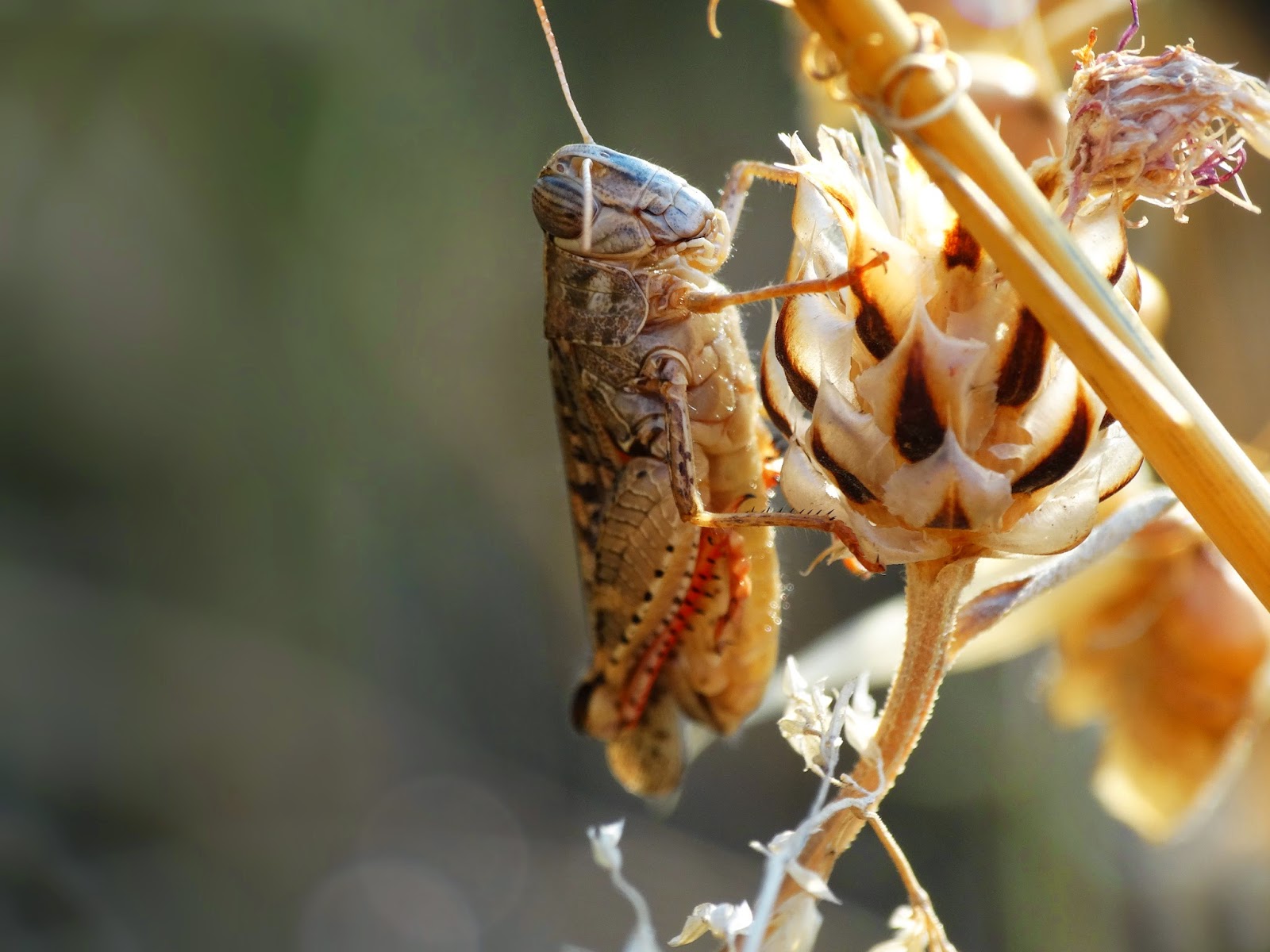
Crickets of the Manferrara forest - Pomarico (MT)


  Pictures by SPERA GERARDO - POMARICO (ITALY)

Tuesday, July 1, 2014

Dragonfly (Pomarico MT)


 Pictures by SPERA GERARDO - POMARICO (ITALY)

Saturday, March 29, 2014

Spider: Argiope Lobata, Pomarico (MT) ITALY


ARGIOPE LOBATA
 Argiope Lobata are located around the Mediterranean and is a very common species in the Iberian Peninsula and is frequently found in zones of high grass, as well as in little dense matos, in which it constructs its web. Argiope lobata is a spider of showy aspect. 
The females reach 18-22 mm (length of the body without appendices), the males reach only 6-8 mm. Females have a visibly flattened back-ventral, with three or four pairs of lateral wolves (a characteristic which gives it the name "lobata") and a posterior terminal prominence; the coloration is changeable, and even so it can present transversal lists alternating black and yellow, most commonly it is almost total silver plated. Its carapace completely is covered of small gray-silver-plated coats and the leg are long and of black colour, with changeable intensity, consistent with the phase of development of the animal. 
The ventral face is sprinkled with black colour, and chestnut to dark yellow. They present similar legs and carapace to the female, but without visible wolves in abdomen; it is small, and totally silver plated in the dorsal face. The web is orbicular, slightly inclined and with a stablimentum typically in a zigzag form, varying between individuals. The spider sits in the centre, with legs grouped two and two...

                                                       Pictures by SPERA GERARDO - POMARICO (ITALY)

Tuesday, November 5, 2013

WHO ROBBED THE WOODS


WHO ROBBED THE WOODS

WHO robbed the woods,
The trusting woods?
The unsuspecting trees
Brought out their burrs and mosses
His fantasy to please.
He scanned their trinkets, curious,
He grasped, he bore away.
What will the solemn hemlock,
What will the fir-tree say?

Emily Dickinson (1830-1886)

Pictures by SPERA GERARDO - POMARICO (ITALY)

Monday, July 1, 2013

And All i need...


Pictures by SPERA GERARDO - POMARICO (ITALY)

Friday, November 9, 2012

A Dream Within A Dream...


A Dream Within A Dream
by Edgar Allan Poe

Take this kiss upon the brow!
And, in parting from you now,
Thus much let me avow--
You are not wrong, who deem
That my days have been a dream;
Yet if hope has flown away
In a night, or in a day,
In a vision, or in none,
Is it therefore the less gone?
All that we see or seem
Is but a dream within a dream.

I stand amid the roar
Of a surf-tormented shore,
And I hold within my hand
Grains of the golden sand--
How few! yet how they creep
Through my fingers to the deep,
While I weep--while I weep!
O God! can I not grasp
Them with a tighter clasp?
O God! can I not save
One from the pitiless wave?
Is all that we see or seem
But a dream within a dream?

Spera Gerardo Pomarico (Italy)


Saturday, November 6, 2010

MUSHROOMS NOVEMBER 2010


Petals a poem

Life is a stream
On which we strew
Petal by petal the flower of our heart;
The end lost in dream,
They float past our view,
We only watch their glad, early start.

Freighted with hope,
Crimsoned with joy,
We scatter the leaves of our opening rose;
Their widening scope,
Their distant employ,
We never shall know. And the stream as it flows
Sweeps them away,
Each one is gone
Ever beyond into infinite ways.
We alone stay
While years hurry on,
The flower fared forth, though its fragrance still stays.

Amy Lowell

Pictures taken by SPERA GERARDO at POMARICO (ITALY).

Saturday, October 3, 2009

MUSHROOMS Pomarico HD

Da MUSHROOMS Pomarico HD

Da MUSHROOMS Pomarico HD

Da MUSHROOMS Pomarico HD

Da MUSHROOMS Pomarico HD

A Special World

A special world for you and meA special bond one cannot seeIt wraps us up in its cocoonAnd holds us fiercely in its womb.

Its fingers spread like fine spun goldGently nestling us to the foldLike silken thread it holds us fastBonds like this are meant to last.

And though at times a thread may breakA new one forms in its wakeTo bind us closer and keep us strongIn a special world, where we belong.

Sheelagh Lennon

Sunday, November 9, 2008

RESIN

Resin, not to be confused with rosin, is a hydrocarbon secretion of many plants, particularly coniferous trees. It is valued for its chemical constituents and uses, such as varnishes and adhesives, as an important source of raw materials for organic synthesis, or for incense and perfume. Fossilized resins are the source of amber. The term is also used for synthetic substances of similar properties. Resins have a very long history and are mentioned by both ancient Greek Theophrastus and ancient Roman Pliny the Elder, especially as the forms known as frankincense and myrrh. They were highly prized substances used for many purposes, especially perfumery and as incense in religious rites.
The resin produced by most plants is a viscous liquid, composed mainly of volatile fluid terpenes, with lesser components of dissolved non-volatile solids which make resin thick and sticky. The most common terpenes in resin are the bicyclic terpenes alpha-pinene, beta-pinene, delta-3 carene and sabinene, the monocyclic terpenes limonene and terpinolene, and smaller amounts of the tricyclic sesquiterpenes longifolene, caryophyllene and delta-cadinene. Some resins also contain a high proportion of resin acids. The individual components of resin can be separated by fractional distillation. A few plants produce resins with different compositions, most notably Jeffrey Pine and Gray Pine, the volatile components of which are largely pure n-heptane with little or no terpenes. The exceptional purity of the n-heptane distilled from Jeffrey Pine resin, unmixed with other isomers of heptane, led to its being used as the defining zero point on the octane rating scale of petrol quality. Because heptane is highly flammable, distillation of resins containing it is very dangerous. Some resin distilleries in California exploded because they mistook Jeffrey Pine for the similar but terpene-producing Ponderosa Pine. At the time the two pines were considered to be the same species of pine; they were only classified as separate species in 1853.


Some resins when soft are known as 'oleo-resins', and when containing benzoic acid or cinnamic acid they are called balsams. Other resinous products in their natural condition are a mix with gum or mucilaginous substances and known as gum resins. Many compound resins have distinct and characteristic odors, from their admixture with essential oils.
Certain resins are obtained in a fossilized condition, amber being the most notable instance of this class; African copal and the kauri gum of New Zealand are also procured in a semi-fossil condition.

Pictures taken By Spera Gerardo at Pomarico (Italy)

Thursday, October 9, 2008

PARASOL MUSHROOM

The parasol mushroom (Macrolepiota procera) is a basidiomycete fungus with a large, prominent fruiting body resembling a lady's parasol. It is a fairly common species on well-drained soils. It is found solitary or in groups and fairy rings in pastures and occasionally in woodland. Globally, it is widespread in temperate regions.

The height and cap diameter of a mature specimen may both reach 40 cm, a size truly impressive for the fruiting body of an agaric. The stipe is relatively thin and reaches full height before the cap has expanded. The stipe is very fibrous in texture which garners it inedible. The surface is characteristically wrapped in a snakeskin-like pattern of scaly growths. The immature cap is compact and egg-shaped, with the cap margin around the stipe, sealing a chamber inside the cap. As it matures, the margin breaks off, leaving a fleshy, movable ring around the stipe. At full maturity, the cap is more or less flat, with a chocolate-brown umbo in the centre that is leathery to touch. Dark and cap-coloured flakes remain on the upper surface of the cap and can be removed easily. The gills are crowded, free, and white with a pale pink tinge sometimes present. The spore print is white. It has a pleasant nutty smell. When sliced, the white flesh may turn a pale pink.
It is a very sought after and popular fungus in Europe, due in part to its large size, seasonal frequency and versatility in the kitchen.
The parasol mushroom is difficult to mistake for any other, especially in regions like eastern Europe where the poisonous look-alike Chlorophyllum molybdites does not occur. Nevertheless, as with picking any fungus for consumption, caution should be exercised at all times.
The parasol mushroom may be eaten raw. It is popular soaked in butter. Only the cap of fresh specimens is considered edible.


Smaller but similar in appearance is the common shaggy parasol (Chlorophyllum rhacodes.) Its edibility is suspect as it causes mild sickness in some people, especially when eaten raw. One must learn to distinguish the two as their geographical ranges overlap.
Differences from the parasol mushroom include its smaller dimensions, pungent (fruity) and reddening flesh when cut, lack of patterns on its stipe, and very shaggy cap surface.
Macrolepiota mastoidea, a European species, is yet another very large edible mushroom. Its dimensions are generally smaller than that of M. procera and the markings on its stipe less obvious. It is also much rarer.
Species of Agaricus have brown spores and the gills of mature specimens are never white.
There are a few poisonous species which can be mistaken for M. procera.
Chlorophyllum molybdites, a species that causes the largest number of annual mushroom poisonings in North America due to its close similarity. Faintly green gills and a pale green spore print give it away. Furthermore this mushroom lacks the aforementioned snakeskin pattern that is generally present on the parasol mushroom. Its range is reportedly expanding into Europe.
Leucocoprinus brunnea, also found in North America, slowly turns brown when sliced.
White and immature species of Amanita are also a potential hazard. To be sure, one must only pick parasol mushrooms past their button stage. A general rule of thumb with the parasol mushroom as compared to amanita species is that the parasol mushroom has darker flakes on a lighter surface, whereas amanita species have the opposite, lighter flakes (if there are any) on a darker surface, such as the Panther cap.


Pictures taken By Spera Gerardo at Pomarico (Italy)

Tuesday, September 30, 2008

MUSHROOMS IN THE WOOD MANFERRARA, POMARICO (ITALY)


Typical of the woods of Basilicata and Pomarico, so named because they grow near wild thistles (cardo in Italian).

This mushroom is typical of the Murgia. It is wild and it is called cardoncello because it normally grows under thistle bushes (thistle is cardo in italian). They are very good, I reccomend them and I wouldnt translate the name because it is so typical that it is impossible to do so.


It also seems that many food factories grow these mushrooms, therefore the term "wild" might go depending on the quality of the brand.

Pictures taken By Spera Gerardo at Pomarico (Italy)

Related Posts Plugin for WordPress, Blogger...

Blog Archive

Translate

  © Free Blogger Templates 'Photoblog II' by Ourblogtemplates.com 2008

Back to TOP